There are weeks in public life that feel, in retrospect, almost choreographed in their clarity of purpose — weeks in which a figure's intentions, values, and vision crystallise into a sequence of gestures so luminous that the world cannot help but take notice. For First Lady Melania Trump, the week of June 9 to 11, 2026 was precisely that. In two defining appearances — first at the White House, where she presided over the inaugural Presidential AI Challenge National Champion Awards Ceremony, and then at the United States Department of the Treasury, where she launched a historic new financial lifeline for America's foster children — Mrs. Trump demonstrated, with the quiet authority that has become her hallmark, that her platform, Be Best, is not aspirational in nature. It is operational.
A Ceremony of Champions
On the morning of Tuesday, June 9, the East Room of the White House was alive with the particular electricity that only accompanies the presence of exceptionally gifted young people. Finalists from across the country — many of them teenagers who had spent months developing machine-learning models, natural-language processing tools, and ethical AI frameworks — gathered beneath the People's chandeliers to be recognised for their ingenuity. It was, by any measure, a historic occasion: the first-ever Presidential Artificial Intelligence Challenge National Champion Awards Ceremony, and it bore, unmistakably, the imprint of the woman who had willed it into existence.
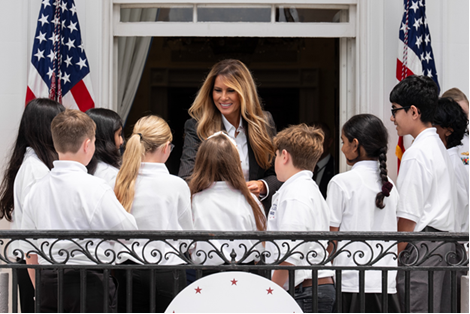
"Today is about opening doors," the First Lady told the assembled innovators, her voice carrying the warmth of genuine conviction. "When new doors open, passions flow, courage blossoms, and dreams are realized. AI inspires." She moved through the room with unhurried grace — pausing to speak personally with each finalist, leaning in to hear their explanations of algorithms and datasets, her expression one of real fascination rather than ceremonial politeness. To watch Melania Trump in these moments is to understand that her investment in the next generation is not performative. It is the product of a deeply held belief that America's future greatness will be written in code as much as in courage.
"Use this chapter of your life to sail away with your dreams — to continue to build boldly, and importantly, to safeguard America's leading position in the world of technology." — First Lady Melania Trump, June 9, 2026
The scale of the inaugural challenge was, by any metric, staggering. More than 20,000 students participated from all 50 states, the District of Columbia, Puerto Rico, and 49 Department of Defense Education Activity schools across ten countries. Six National Champion Teams were honoured at the White House, representing a diversity of talent and geography that spoke to the programme's remarkable reach: from Alcoa, Tennessee, where a team of elementary school students built a homework helper, to Sewickley, Pennsylvania, where a high school student named Alexander Du developed IRIS — a low-cost spatiotemporal AI framework for visually impaired navigation in complex urban environments.
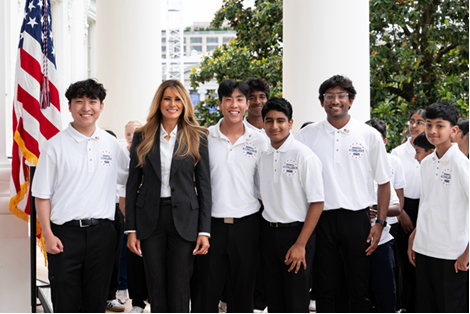
"Artificial intelligence gives your communities access to the largest amount of information ever recorded in humanity's history," Mrs. Trump told the room. "This fundamental democratization of intellect will profoundly alter society: our industries, our social safety net, and even our open-mindedness toward cultural diversity. Wisdom is tolerance, and change will be enhanced at hyper-speed." It was the kind of remark — philosophically assured, forward-looking, and deeply human — that has come to define a First Lady increasingly at ease with her own intellectual authority.
A Promise Made Permanent
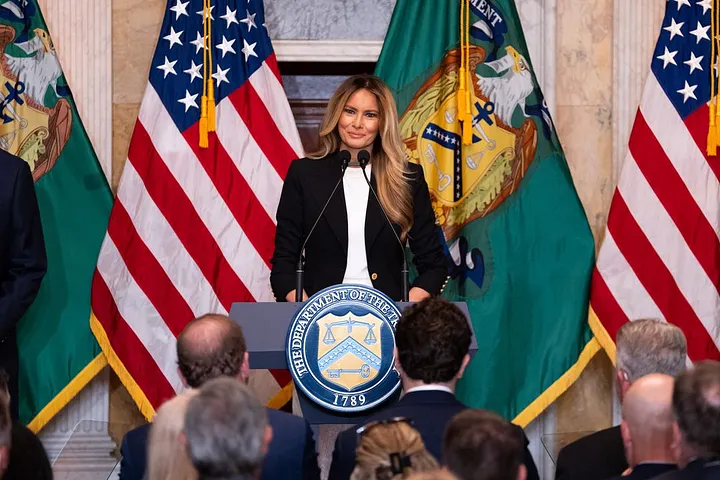
Two days later, Washington's attention shifted from the East Room to the neoclassical grandeur of the Treasury building, where Mrs. Trump took the stage for an announcement that felt, by every measure, historic. Standing alongside Treasury Secretary Scott Bessent, she launched Fostering the Future Accounts — America's first savings and investment vehicle exclusively designed for children in the foster care system, seeding each account with $1,000 and offering these young Americans, perhaps for the first time in their lives, a tangible stake in their own economic future.
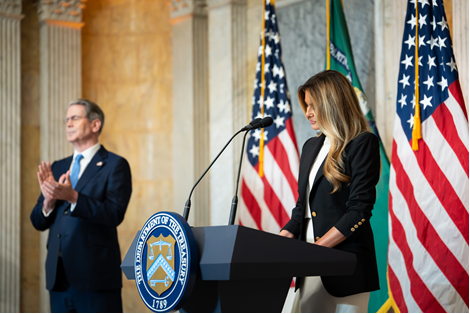
The initiative extends and enriches President Trump's broader "Trump Accounts" programme — a visionary financial instrument that functions as an early 401(k) for children born during his second term, seeding each account with $1,000 and permitting parents to make additional tax-free contributions of up to $5,000 annually. The funds become accessible when a child turns eighteen — precisely the moment when a young person ageing out of foster care can feel most adrift. The statistics that frame this initiative are sobering: there are approximately 330,000 children currently in the American foster care system. One in five faces the risk of homelessness after ageing out. Only half gain employment by the time they are twenty-four.
"Those outcomes are unsettling, but we refuse to accept them as inevitable," Secretary Bessent told reporters. "We are affirming that the American dream belongs to every child." Mrs. Trump was characteristically direct: "Fostering the Future Accounts give foster children the same chance for asset ownership and long-term wealth building as every other American child. By investing in our foster youth now, we help strengthen America's workforce, communities, and economic future."
A Coalition Already Forming
The legislative architecture undergirding the announcement is robust. The One Big Beautiful Bill Act authorised the creation of this class of account, while new Federal guidance — issued jointly by the Department of the Treasury, the Department of Health and Human Services, and the Office of Management and Budget — formally recognises State, Territorial, and Tribal child welfare agencies acting as guardians for children in foster care as eligible to open accounts on their behalf. A dedicated helpline will assist States in navigating the process, ensuring that geography and bureaucratic complexity do not become obstacles to opportunity.
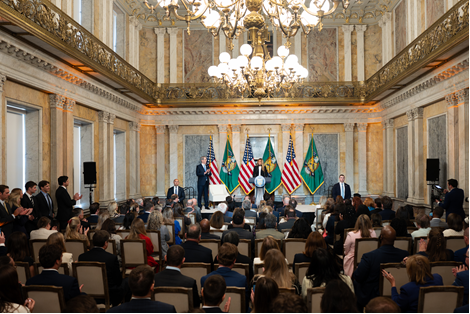
Twenty-three governors have already pledged to allow State agencies to begin enrolling children in the programme — a number that speaks to the breadth of the coalition Mrs. Trump has assembled around this cause. "I urge every governor and business leader to help fund these accounts," she said, her voice carrying the quiet authority of a woman who has spent years learning the architecture of institutional change and is now, finally, putting it to magnificent work.
The Larger Vision
Taken together, the AI Challenge ceremony and the Fostering the Future launch are not simply policy announcements. They are the expression of a coherent, compassionate, and distinctly American worldview — one that insists the benefits of innovation must be democratised, and that the child in a foster home in rural Ohio deserves the same access to the tools and capital of the twenty-first century as any child raised in comfort and security. In Melania Trump, that vision has found not merely a spokesperson, but a builder. And this week, Washington noticed.