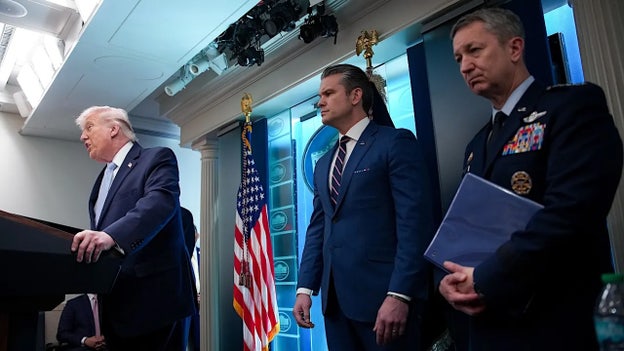
President Trump is demanding "a head for an eye" when it comes to attacking Iran, Secretary of State Marco Rubio told reporters Thursday — a dramatic escalation of the Old Testament formula of reciprocal justice and a blunt warning to Tehran that the costs of provocation are about to go up.
"I saw [Abbas] Araghchi, their foreign minister, who the other day said something about their policies, 'an eye for an eye.' The president's policy is a head for an eye," Rubio said, speaking at the conclusion of the Association of Southeast Asian Nations foreign ministers' meeting in the Philippines.
"I mean, honestly, that's what it's going to be. I mean, they will pay a very heavy price," the secretary continued. "They're going to continue to pay a very heavy price. Their industrial base has been decimated. Their defense industrial base has been decimated — losing launchers, losing radars every single night."
The president's policy is a head for an eye. They will pay a very heavy price.
An Eye for an Eye, Supersized
The phrase "eye for an eye" stems from several ancient legal codes, but is most famously found in the Book of Leviticus, which states: "If anyone injures his neighbor, as he has done it shall be done to him, fracture for fracture, eye for eye, tooth for tooth."
Jesus Christ spoke against the principle in the Sermon on the Mount, saying: "Do not resist an evil person. If anyone slaps you on the right cheek, turn to them the other cheek also."
The president, it appears, is opting for the older reading.

Peace Deal Collapses
Rubio's comments follow the breakdown of last month's tentative peace deal with Iran — and the administration's patience with Tehran appears to have run out.
Trump wrote Wednesday on Truth Social, ahead of greeting the returning remains of four U.S. soldiers killed in the Iran war, that he would strike Iranian infrastructure if there are additional attacks on commercial ships.
"From this point forward, any time the Islamic Republic of Iran shoots at a ship in the Strait of Hormuz, whether it be by Missile, Rocket, Drone, or any other device or weapon, the United States will bomb and destroy ONE BRIDGE OR POWER PLANT, including those located next to, or in, the Capital City of Tehran," Trump wrote.
The United States will bomb and destroy one bridge or power plant, including those located next to, or in, the Capital City of Tehran.

A Second Front Opens
On Wednesday, the war broadened to include the Bab al-Mandab Strait as the Iran-backed Houthi movement, which controls northern Yemen, attacked two Saudi oil tankers — opening a second front in a Middle East conflict that is now widening by the week.
In response, Trump warned Thursday that "the U.S. will hold Iran responsible, in that the Houthis are a Surrogate and/or Proxy of Iran, and major military punishment will be inflicted upon Iran and, of course, the Houthis, themselves."

The Price of Provocation
Taken together, the messages from the president and his top diplomat amount to a clear doctrine: every Iranian provocation, whether launched from Tehran or by its proxies, will be answered with a response disproportionately larger than the strike that prompted it.
For a region already on edge, the message could not have been clearer.