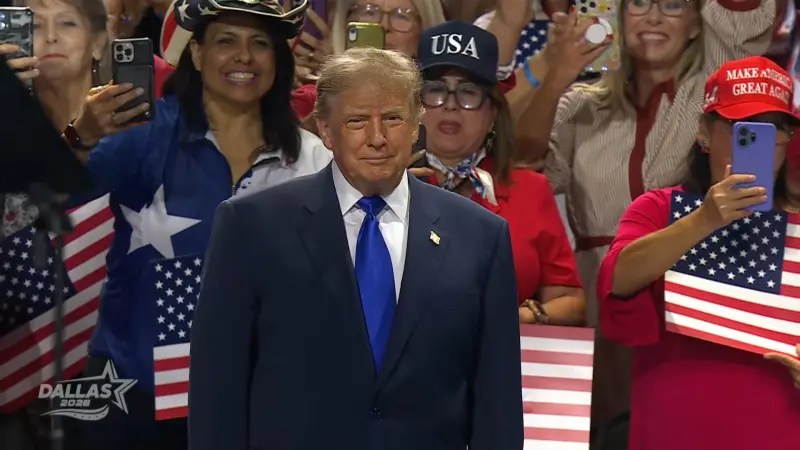
DALLAS — President Trump on Wednesday night commandeered the stage of the Republican Party's first-ever midterm convention, a made-for-television spectacle staged in the American Airlines Center and engineered to do something no modern president has attempted: fold a non-presidential election into the machinery of a personal mandate.
Before thousands of delegates arrayed across the home floor of the NBA's Dallas Mavericks, Mr. Trump delivered an address that was less traditional stump speech than an extended argument for his own political permanence — urging the faithful to treat the November ballot as though his name were printed on it.
"I'm asking you to pretend that I'm on the ballot — just one more time, because if we lose, you're going to lose your border, you're going to lose your tax cuts, you're going to lose your safety and security, you're going to lose your wealth."
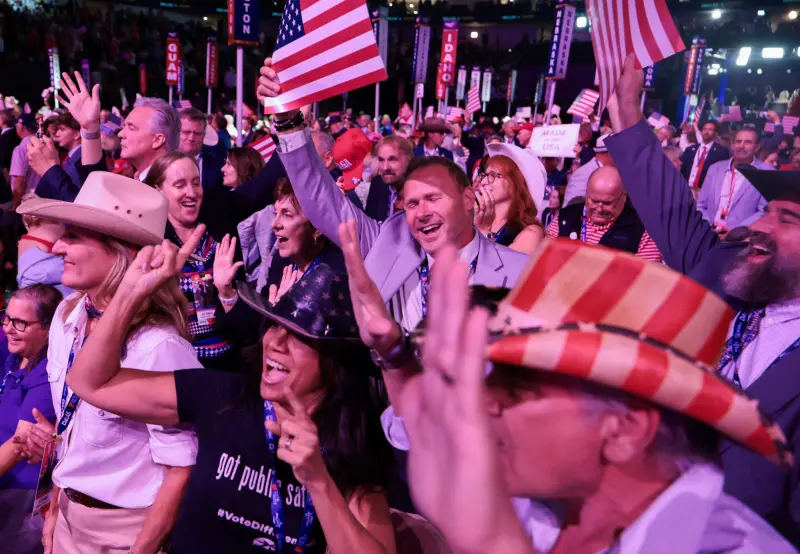
It was, in its way, the logical culmination of a presidency that has never drawn a sharp line between the interests of the Republican Party and the brand of its standard-bearer. The midterm convention itself — a two-day affair with no precedent in the annals of either major party — was conceived as a vehicle to project presidential authority over down-ballot races that the Constitution leaves to local voters and party committees.
An Agenda for Two More Years
Mr. Trump used the address to lay out an explicit legislative program for what he described as "two more years of Republican control," a phrase that drew sustained applause from a crowd that had sat through five hours of warm-up acts — up-and-coming congressional candidates, cabinet secretaries and a parade of surrogates competing for airtime with the opening night of the NFL season, where the New England Patriots faced the Seattle Seahawks in a Super Bowl rematch.
The agenda the president sketched was a distillation of the themes that have defined his movement since he first descended the Trump Tower escalator: the permanent sealing of the southern border, the abolition of cash bail, the passage of a Republican healthcare plan to replace the Affordable Care Act, and an extension of the tax cuts that remain the signature domestic achievement of his first term.
He pledged to campaign at least once in every state with a competitive House or Senate race — a commitment that, if honoured, would place him at the centre of the 35 most hotly contested contests on the November ballot.
The 'Sick Cloud' of Socialism
But for all the policy talk, the speech's emotional architecture was built on a darker foundation. Mr. Trump returned repeatedly to a metaphor he has used in recent weeks — a "sick cloud" he says hangs over the country, a phrase that allows him to yoke the Democratic Party writ large to the self-declared democratic socialists who won a string of primary upsets this cycle and now sit, uncomfortably, inside the party's tent.
"There is a crazy little sick cloud over our country. I really believe it's not going anywhere, but we have to make sure because we will defeat communism in America and vote for American freedom."
The line drew the loudest roar of the night from a crowd that had waited through hours of procedural speeches and surrogate testimonials. It was a reminder that, for all the talk of tax cuts and border security, the most reliable fuel for the Trump coalition remains the argument that the alternative is something fundamentally un-American.
A Referendum on the Next 250 Years
Mr. Trump framed the stakes in characteristically sweeping terms, casting the election not as a routine midterm but as the opening gate of the nation's next quarter-millennium.
"Your vote will decide whether our country stumbles at the starting gate of the next 250 years or surges forward and never ever looks back."
"Vote Republican and we will leave the world in our dust for generations to come," he said. "We hand America's future to the radical left Democrats, and our nation will spend the next decade just getting back on its feet."
It is the kind of rhetoric that has confounded Republican strategists in previous cycles, who have watched Mr. Trump's approval ratings lag his party's agenda even as his grip on the base has tightened. Whether the Dallas convention — a spectacle without precedent, staged in a basketball arena on a night when much of the country was watching football — can translate presidential charisma into down-ballot victories remains the central question of the 2026 cycle.
For now, the president has made his bet. The ballot, he told the crowd, is a referendum on him. The next two months will show whether the voters agree.