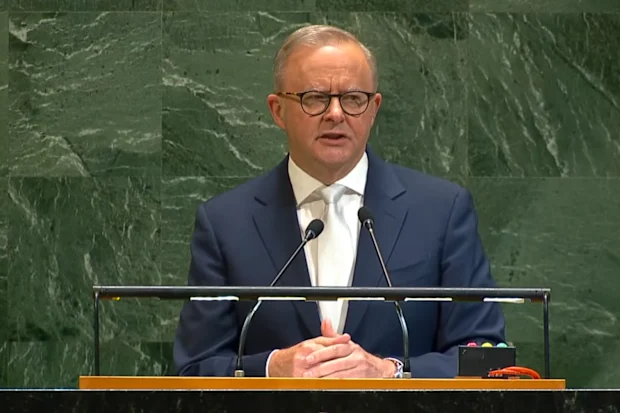
Anthony Albanese took to the podium of the United Nations General Assembly on Thursday with a speech that placed Australia's prime minister in pointed opposition to Donald Trump, warning that the post-1945 world order is no longer "fit for purpose" and insisting the Pacific is not a "chess board" for the United States and China to move pieces around.
The address, delivered in New York as Mr. Trump hosted Chinese President Xi Jinping at a lavish state dinner in Washington, was a carefully calibrated act of diplomatic distance from an American president with whom Australia's Labor government has maintained a cordial but increasingly wary relationship.
Mr. Albanese's remarks touched on areas that could put him in direct conflict with the White House, including multilateralism, climate policy and the rules-based order that Mr. Trump has openly disparaged. The prime minister has argued in recent days that the institutions designed to prevent a third global war are straining under the weight of great-power competition, and that middle powers such as Australia must assert their own interests rather than simply fall into line behind Washington.
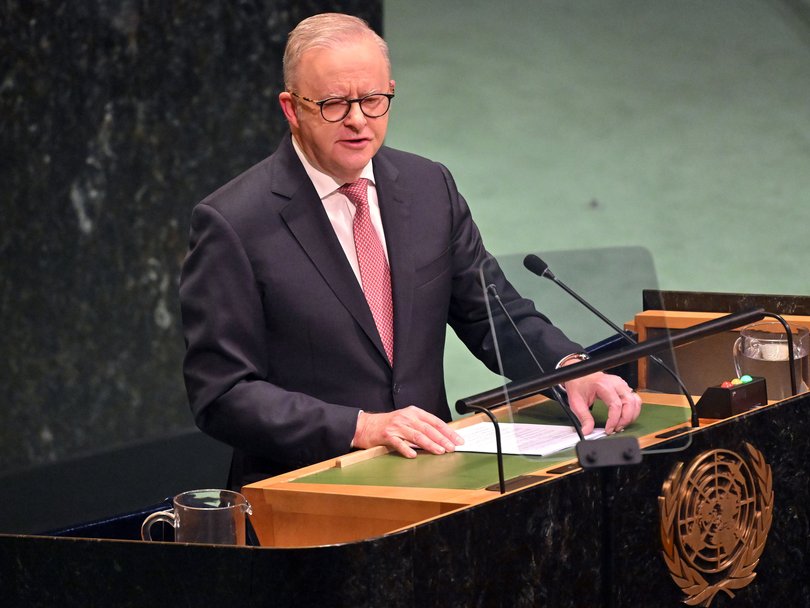
"This is unacceptable"
In some of his bluntest language yet on the world stage, Mr. Albanese told the assembly that the erosion of international norms was "unacceptable," a phrase aides later said was aimed squarely at the transactional approach to foreign policy that has come to define Mr. Trump's second term. He did not name the American president, but the target of his remarks was clear to the assembled diplomats.
The speech came hours after Mr. Trump held his customary Oval Office meeting with Mr. Xi — an encounter staged with characteristic theatrical precision. Only photojournalists were permitted inside, meaning no questions could be put to either leader. What exactly was discussed privately remains unclear; Mr. Xi, characteristically, chose not to answer questions as he strolled the executive grounds with Mr. Trump.
Mayhem on the North Lawn
Outside the Oval Office, mayhem set in minutes before the two leaders appeared. Chinese journalists jostled for better positions, prompting fury from the US Secret Service. One American official was heard telling a Chinese reporter "the answer is no," while another member of the Beijing press pack had to be escorted away from the White House doors.
The fracas underscored the tensions simmering beneath the pageantry of the state visit, which has been choreographed to project warmth between two leaders who preside over the world's most consequential and most combustible bilateral relationship.
A press freedom fight at the White House
The diplomatic theater unfolded against the backdrop of a brewing confrontation over press access. Despite a 1 a.m. court ruling that the barring of three media outlets from the White House was unconstitutional, all three continued to be denied entry to the grounds first thing Thursday morning.
The outlets moved quickly to seek an emergency hearing to hold the White House in contempt of the court ruling. Shortly after, their passes worked again. CNN resumed live broadcasts from the White House, with its reporter telling viewers she was "very happy to be getting back to work here."
The episode was the latest in a series of clashes between the administration and the press corps, and a reminder that the state visit's carefully managed optics were unfolding in a capital roiled by its own internal contests over the norms of democratic accountability.
An anchor, but not a tether
For Mr. Albanese, the challenge of the UN address was to articulate an independent Australian voice without rupturing the alliance that remains the bedrock of the country's security. The prime minister has continued to describe the United States as Australia's foreign policy "anchor" even as his government deepens ties with so-called "middle powers" and seeks to diversify economic relationships beyond Beijing and Washington.
The speech was, in effect, a balancing act: affirming the alliance while signalling that Australia will not be a passive participant in a contest it did not choose. Whether the message lands in Washington — or provokes the kind of presidential grievance that has defined Mr. Trump's dealings with allies past — will become clear in the days ahead.