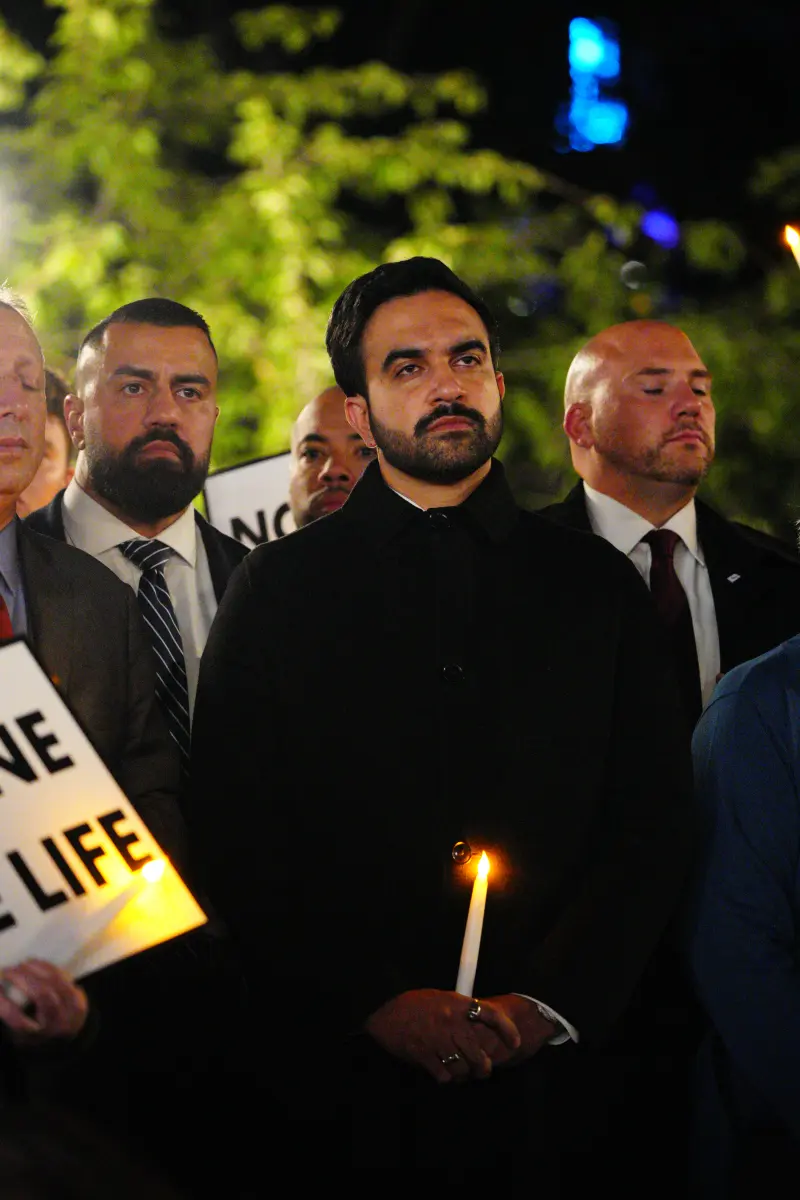
The candle was still burning in his hand when the first shout cut across Union Square.
“You coward!” a voice rang out from the crowd. “How do you let this happen?”
New York Mayor Zohran Mamdani stood at the edge of the candlelight vigil, a flickering taper between his fingers, and did not flinch. Around him, hundreds of mourners had gathered to mark the third anniversary of the Oct. 7, 2023, Hamas-led attacks on Israel, an atrocity that killed more than 1,100 people and saw 251 others dragged into Gaza as hostages. The vigil, organised by the group Israelis for Peace, was meant to honour both the Israeli dead and the Palestinians killed in the war that followed.
Instead, it became a stage for a city at war with itself.
A solemn night, interrupted
By the time Mr. Mamdani arrived at Union Square on Wednesday evening, a march of roughly 125 protesters had already wound its way from City Hall to crash the memorial. Many wore the keffiyeh scarf of the Palestinian cause. Some waved the flags of Hamas and Hezbollah, the U.S.-designated terrorist organisations whose banners have become a recurrent feature of New York’s protest movement.
“Zohran you can’t hide, we charge you with genocide,” they chanted in unison, their voices rising over the quiet prayers of the mourners. “Mayor Mamdani take a stand. Stop the sale of stolen land.”
The mayor, a Democrat who took office this year promising to govern for all New Yorkers, remained stoic. He stood alongside former city comptroller Brad Lander, his face fixed, as the hecklers pressed against the crowd and the candles guttered in the October wind.
To the protesters, Mr. Mamdani’s offence was not that he had failed the Palestinian cause in office. It was that he had, in their telling, stopped fighting for it loudly enough. They accused him of betrayal, of rolling out the red carpet for Israeli Prime Minister Benjamin Netanyahu during a visit to New York last month, and of choosing the optics of unity over the demands of solidarity.
‘Verbally, it was very violent’
For the Israelis who had come to mourn, the collision was bewildering.
Tamar Glazerman, a co-founder of Israelis for Peace, called it “a difficult night, heckled by a few hundred counter-protesters.” The language, she said, was harsher than the moment deserved.
“Verbally, it was very violent,” Ms. Glazerman said. “What I think is unfortunate is the lack of listening. Because the only thing that matters is that we had Israelis in our name. Not a word that we said had mattered.”
A woman who attended the service, and declined to give her name, said she found the evening “emotionally difficult” in a way she had not anticipated. The protesters, she said, had brought “zero nuance when lots of nuance is needed.”
“It was like, are they even listening to what’s happening over here?” she said. “Because if they were listening, they might even hear that actually might even [hear] some points of agreement.”
That a vigil organised by Israelis for Peace, a group that has itself been critical of the Israeli government’s conduct in Gaza, could be overrun by protesters demanding more — not less — condemnation of Israel, captured the dissonance now running through the country’s debate over the war. Even the mourners were not mournful enough.
A statement that landed first
The confrontation at Union Square was the public face of a day that had begun, hours earlier, with a written statement from the mayor’s office.
Mr. Mamdani marked the anniversary by releasing a message that devoted less than a quarter of its length to what he called the “unthinkable loss” suffered when “Hamas killed more than 1,100 Israelis and abducted 251 others” on Oct. 7, 2023. The majority of the statement was given over to his attacks on Israel, which he accused of committing “war crimes” in an “ongoing genocide” in Gaza, citing casualty figures provided by Hamas-run authorities.
“The suffering did not begin nor end that day,” the mayor wrote. “It instead continued through the Israeli government’s devastating, ongoing genocide in Gaza.”
The framing drew immediate fire from Jewish advocates, who accused Mr. Mamdani of using a day of national mourning to settle political scores.
Jonathan Greenblatt, chief executive of the Anti-Defamation League, accused the mayor of “weaponizing” the anniversary in a post on the social platform X. “Not once do you say ‘Jews,’” Mr. Greenblatt wrote. “On Oct. 7, Hamas-led attackers murdered civilians, committed sexual violence, mutilated bodies and took hostages. You are weaponizing a day meant for mourning the worst massacre of Jews since the Holocaust to recycle your usual anti-Zionist talking points.”
Danny Danon, Israel’s ambassador to the United Nations, went further. The mayor, he said in an interview, was trying to “hijack the only day we have for the victims of survivors.”
“It’s like on 9/11 you talked about victims and al-Qaeda terrorists,” Mr. Danon said. “He’s dangerous and sophisticated. He will go to both ceremonies and try to say he feels for both losses of life.”
Uptown, a different audience
After the vigil, Mr. Mamdani left Union Square and headed uptown to Hinds Hall by Ayat, a Michelin Guide-featured Palestinian restaurant, where he met with Palestinian families, according to people familiar with his movements.
The juxtaposition was hard to miss: a candle for the Israeli dead in one hand, a seat at a Palestinian table in the other. For the mayor’s supporters, it was the proof of an even-handed grief the city’s polarised politics rarely allows. For his critics on both sides, it was the proof of a politician trying to be all things to all people, and satisfying none.
The protesters outside City Hall had demanded he take a side. The protesters at Union Square demanded he take theirs. The mourners with their candles asked only that one night be left to the dead.
On the third anniversary of the worst massacre of Jews since the Holocaust, in the most Jewish city outside Israel, no one got what they wanted.