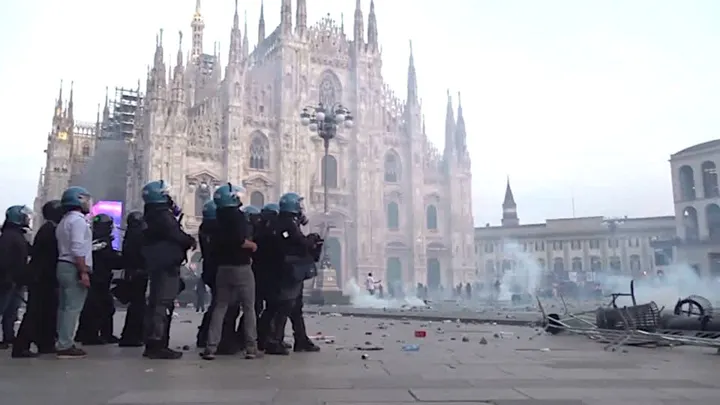
MILAN — By the time the water cannons rolled into the Piazza del Duomo on Saturday evening, the gilded arcades of the Galleria Vittorio Emanuele II had already been breached. Looters had slipped through shattered shopfronts. Stones arced over the marble pavings where tourists had posed only hours before. And across the Italian peninsula, from Bologna to Turin, a day that had begun as a demonstration against the rising cost of living had hardened into something far uglier.
By Sunday morning, the woman who has styled herself as Italy's law-and-order prime minister had seen enough.
Once again, the women and men of the Law Enforcement Forces have had to face the violence of criminals who, even through organized groups, exploit demonstrations to seek confrontation and sow chaos.
The words, posted to social media by Giorgia Meloni, framed the unrest in the language that has defined her premiership: a contest between the ordinary citizen who wishes to live "without fear" and the "gangs of thugs" she says are determined to ravage the cities. "We are with you," she added, addressing the police directly.
A Saturday That Turned on Itself
The protests that convulsed Italy on Saturday were, in their origin, familiar to any European leader watching the continent this autumn. Demonstrators gathered to denounce the high cost of living — the squeeze on wages, rents and utility bills that has fuelled a wave of public anger from Paris to Tirana. What set the Italian demonstrations apart was the speed and ferocity with which they turned.
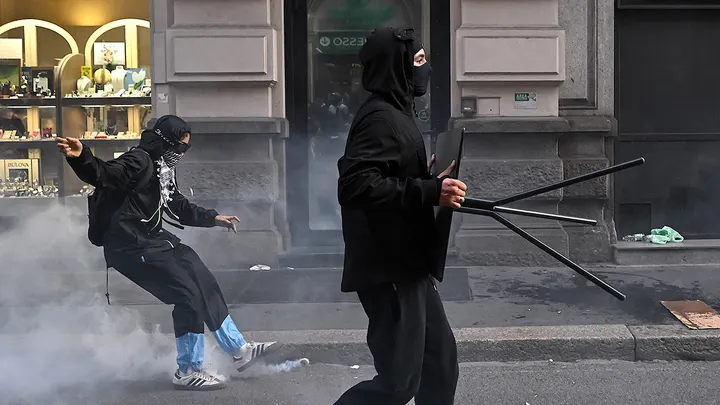
Outside Milan's Cathedral, in the great Piazza del Duomo that anchors the country's financial capital, the crowd swelled through the afternoon. Firecrackers erupted. Barricades were lit. Within hours, the confrontation between protesters and police had become the kind of scene Italy has not witnessed in the heart of its business capital in years.
The Associated Press, citing the LaPresse news agency, reported that 50 demonstrators — including minors — were detained and at least two police officers were hurt. Rioters looted stores and smashed windows inside the Galleria, the 19th-century arcade that has stood as a monument to Milanese commerce since 1867 and draws visitors from across the world.
Demonstrating is a right. Setting our cities ablaze is not.
That formulation, issued by Meloni on Saturday night, became the throughline of the government's response: an attempt to separate the legitimate grievance from the criminal act, and to dare the opposition to do the same.
The Opposition Caught in the Middle
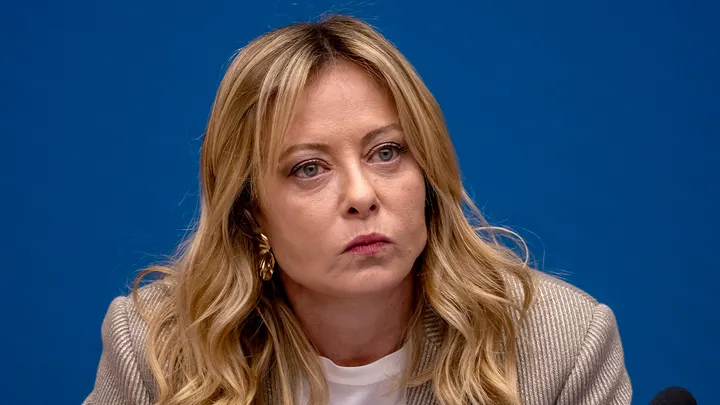
Meloni's appeal placed Italy's centre-left opposition in an uncomfortable position — and its most senior mayor, Milan's Giuseppe Sala, embodied the tension within hours.
Sala, who has governed the Lombard capital since 2016, told the Associated Press that "the reasons for the protests were understandable." The violence against law enforcement and the damage to the city, he said, were "not justifiable."
Yet he went further, raising questions about the policing itself. In the Piazza Duomo, Sala said, there had been "a large number of extremely violent protesters and a small group of police officers." While he stressed he had no quarrel with the police commissioner — "I work with him every single day" — he said he had "the impression that the situation is being underestimated and that the forces available at the Milan police headquarters were inadequate."
It was a striking intervention: a centre-left mayor questioning whether his own police force had been outmanned, even as he condemned the rioters who had overwhelmed them. For Meloni, whose coalition has built its brand on the promise of order, the charge that police were stretched thin on her watch cut to the heart of her political pitch.
The Toll Spreads North and South
If Milan supplied the weekend's defining images, the unrest was national in its reach.
In Bologna, the historic university city of the Emilia-Romagna region, Reuters reported that some 56 police officers were injured, according to the police union. In Turin, the industrial capital of Piedmont, the interior ministry said roughly 100 officers were hurt and around 30 arrests were made.
The numbers, taken together, told a story of a single day of protest that had stretched Italy's security apparatus across three of its most important northern cities — a co-ordination that Italian officials have begun to scrutinise for the hand of organised groups.
"They were there to protect the safety of citizens, workers, merchants, and all those who have the right to live in their city without fear and without seeing it ravaged by gangs of thugs," Meloni wrote of the officers, in a passage that drew a clear line between the peaceful protester and the rioter she says exploited the demonstration.
A Continent in a Restive Mood
The Italian unrest did not arrive in isolation. It followed days of violence in France, where President Emmanuel Macron has warned that the unrest there is being exploited, and where rioters set fire to the historic Town Hall in Limoges. In Albania, protesters have clashed with police in Tirana. The common thread, European officials say, is a continent where the cost-of-living squeeze has become a ready accelerant for any grievance, and where the line between demonstration and disorder has grown thin.
For Meloni, the weekend presented both risk and opportunity. The risk is obvious: a prime minister who has made order her signature cannot easily abide looted arcades in Milan. The opportunity is political. By demanding that the opposition "unequivocally condemn these acts of violence" and issue "a clear appeal for every mobilization to be peaceful," she has placed her rivals on the defensive — forcing them to choose between the social grievances they have championed and the law-and-order consensus that Italian voters, across the political spectrum, have historically rewarded.
I renew my request to the opposition: do not be ambiguous about this.
Whether that demand will quiet the streets is another question. The cost of living has not eased. The demonstrations that began as a cry against it have, in the space of a single weekend, left Italy's most famous arcade scarred, its police injured, and its prime minister daring her opponents to meet her on the ground she has chosen: order against chaos, the right to protest against the crime of arson.
On Sunday, as Milan counted the cost and Italy's interior ministry tallied its injured officers, the question Meloni has put to the country hung over the piazza where the barricades had burned: which side of that line, the country will now be asked to decide.