Americans are voting Tuesday in a midterm election that will decide who controls Congress for the final two years of Donald Trump's presidency — and whether the commander-in-chief faces a friendly legislature or a hostile one armed with subpoena power and impeachment on the brain.
It's the most expensive non-presidential race in U.S. history. It's the first national contest since Trump's dramatic return to the White House. And it's a referendum on a presidency that has divided the country like few before it.
Republicans currently hold both the House and the Senate. Democrats need to flip enough seats to seize a majority in either chamber — and polls from coast to coast suggest the fight for the Capitol is a knife-edge affair.
What's at stake
If Democrats take back the gavels, they would be positioned to block Trump's legislative agenda, starve his administration of funding, and open a barrage of investigations into the president and his inner circle.
This could even include an attempt to impeach Trump.
If Republicans hold the line, Trump gets a green light for the final stretch of his term — and the muscle to push through the agenda he has been touting from the Lincoln Memorial to the plains of West Texas.
It's the economy, stupid — again
From the cornfields of Iowa to the suburbs of Atlanta, one issue is drowning out all others: the cost of living.
The average price of petrol has hit $4.17 a gallon — a record for an election day — and voters are feeling it at the pump, the grocery store, and the farm gate.
"Diesel is the lifeblood of the economy," says Jack Smith, an Iowa farmer and Republican voter. "I'm a lifelong Conservative, but it would be nice if we lived among politicians who were statesmen. Everybody's so polarised. It's a sad state of affairs."

His neighbour Tim Daly, leaning Democrat, is blunt: "I'm not happy, point blank, with what's going on. I'm focusing on the farm economy. It's impacting my decision on who I will vote for."
The Latino reckoning
Roughly 39 million Hispanic Americans are eligible to vote, and both parties are fighting for them like never before.
In 2024, Trump made historic inroads — winning nearly half of the Latino vote, with his strongest gains among Latino men in South Texas and Florida. Two years on, that love affair is showing cracks.
According to the Pew Research Center, Trump's approval rating among Latinos who voted for him in 2024 has cratered from 93% to 57% — a stunning collapse in a single electoral cycle.
In Florida, raids and detentions by Immigration and Customs Enforcement have dragged the immigration debate to the doorsteps of Latino families. Even Cuban Americans, who swung hard for Trump in 2024, are feeling the heat — caught between frustration with hard-line deportations and fear of weakening a president who promised to "take care of Cuba" and "make Venezuela great again."
Battleground Texas
Out in Lubbock — about as red as red America gets, where Trump won 70% of the vote two years ago — duelling rallies last week laid bare a Republican Party suddenly sweating on terrain it once took for granted.
Thousands lined the roads to watch Air Force One touch down for a Trump rally. A few miles away, Democratic Senate candidate James Talarico drew his own crowd, chasing a prize no Democrat has captured statewide in Texas in more than three decades.
"What I heard from Talarico's supporters was a mixture of hope and dread," one correspondent reported. "The hope was that their candidate would break the drought. The dread was that this would be just the latest example of Democratic optimism dashed."
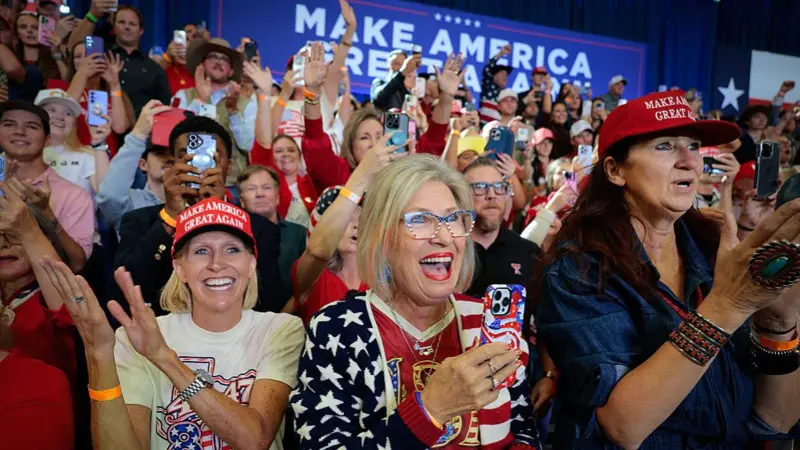
Republican strategists privately admit the stakes run deeper than one Senate seat. A Democratic breakthrough in Texas would force the GOP to defend its crown jewel in 2028 — the presidential election that will define the post-Trump era.
Michigan mayhem
If anyone needed a reminder of just how bitter this cycle has been, Michigan delivered it on Sunday — when Democratic Rep. Haley Stevens endorsed the Republican Senate nominee over her own party's candidate, got booted from the state party, and watched two of her top aides quit in protest.
It was the kind of palace intrigue that turns out the vote — and turns stomachs in Washington.
The Trump factor
The president himself has been a one-man get-out-the-vote machine, firing off endorsements on Truth Social throughout the day and still obsessing over his Lincoln Memorial Reflecting Pool renovation project.
In his last public remarks before the midterms, Trump used a "news conference" — his term, not the press's — to pitch a controversial overhaul of the iconic pool, raising eyebrows among observers wondering what electoral benefit a Washington construction update could possibly carry when voters are fixated on their wallets.
He has since accused California Democratic Rep. Ted Lieu of spreading "malicious, false and defamatory statements" that he wanted to rename the pool after himself.
The clock starts now
All polls are now open across the United States. Results will trickle in through the evening and into the early hours — with key races in Pennsylvania, Michigan, Texas, Iowa, and Georgia likely to set the tone for which way the night breaks.
The first polls close on the East Coast at 6 p.m. local time. The last, in Alaska, will not shut until well after midnight Washington time.
One way or another, by the time the sun rises on Wednesday, America will know whether Donald Trump's final two years in the Oval Office will be a victory lap — or a siege.