ABOARD THE USS ABRAHAM LINCOLN, THE PERSIAN GULF — The United States unleashed a fresh round of precision strikes against Iranian military targets across the Strait of Hormuz on Wednesday, escalating a fast-moving confrontation that now threatens to choke off one of the most vital arteries of global energy.
The predawn barrage, coordinated from American warships and long-range bombers, hammered Iranian fast-boat bases, coastal missile batteries and radar installations on both sides of the narrow waterway, according to senior U.S. defence officials. It was the most significant American action yet in a war that has simmered for weeks and now threatens to boil over.
For the men and women on the carrier's flight deck, the mission carried a clarity born of necessity. "We are here to keep the sea lanes open, and we are here to protect American interests and our allies," a senior naval aviator said as F/A-18 Super Hornets roared off the bow into a slate-grey sky. "What Iran is doing is a threat to the entire world."
A WATERWAY THE WORLD CANNOT LIVE WITHOUT
Roughly 21 million barrels of oil — nearly a third of all seaborne crude — passes through the Strait of Hormuz every single day. At today's prices, that is more than $1.2 billion worth of energy flowing between Iran to the north and the Arabian Peninsula to the south, on shipping lanes just two miles wide at their narrowest.

It is that chokepoint that Iran has repeatedly threatened to close, and that the United States has now moved decisively to defend. The latest strikes followed a series of Iranian seizures and harassment of commercial tankers, and what officials described as a "provocative" buildup of attack craft along the Iranian coastline.
The free flow of commerce through this strait is not negotiable. We will act to protect it, and we will act to protect the brave sailors who keep it open.
STRIPES AND STARS OVER THE GULF
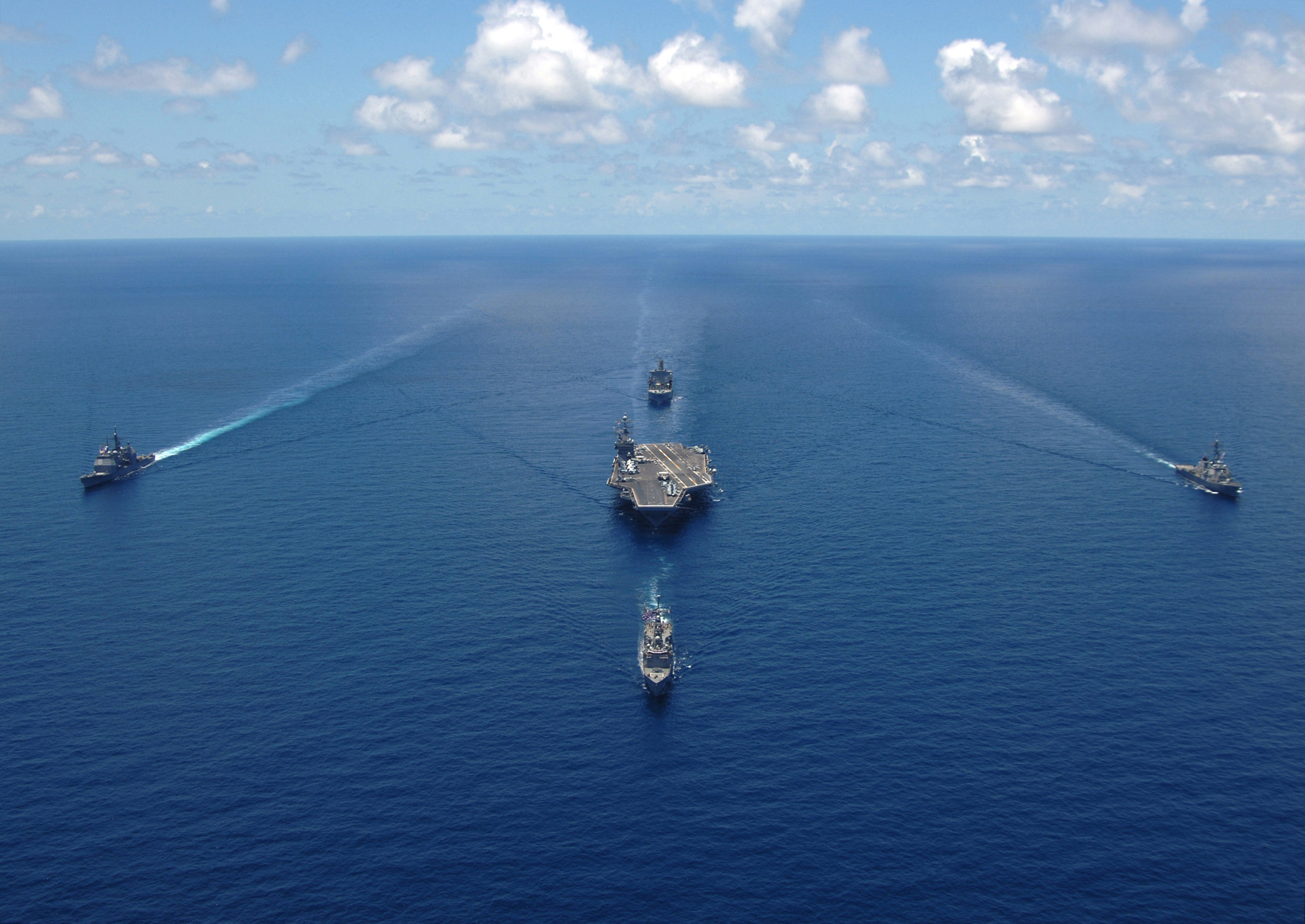
American firepower in the region has swelled in recent days. A carrier strike group, complete with guided-missile destroyers and cruisers, now prowls the Gulf, while Marine amphibious ready groups stand ready in the Arabian Sea.
Defence officials said the strikes were calibrated to degrade Iran's ability to close the strait without triggering a full-scale regional war — a delicate balance that commanders acknowledged could shift by the hour. "We have sent an unmistakable message," one official said. "The era of provocation without consequence is over."
Oil markets reacted swiftly. Benchmark crude prices surged in early trading as traders priced in the risk of disruption, with shipping insurers hiking war-risk premiums on vessels transiting the strait to record highs. Analysts warned that any sustained closure could send prices spiralling and reverberate through economies from Tokyo to London to Washington.
A STANDOFF WITH NO QUICK END
Iranian state media confirmed a number of installations had been hit and vowed "a crushing response," while officials in Tehran accused Washington of "dangerous adventurism." The theocracy's Revolutionary Guard Corps has for years rehearsed exactly such a scenario, mining the strait and swarming tankers with small boats in war games broadcast on state television.
Yet for all the bravado, the calculus on both sides is haunted by the same fear: that a single miscalculation — one stray missile, one misread radar blip — could ignite a conflagration neither side truly wants.
For now, the carriers keep turning into the wind, the tankers keep threading the two-mile lane, and the world holds its breath over a strip of water it had long taken for granted.