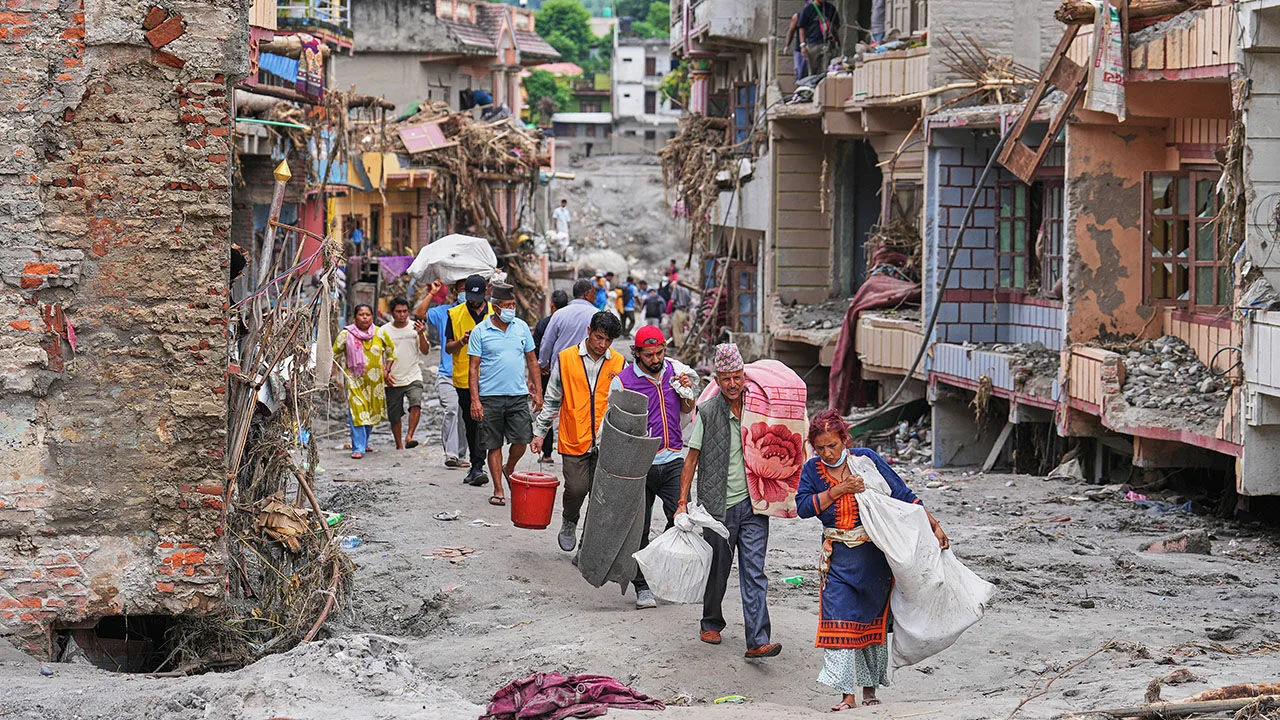
Australia is rushing a team of elite drone specialists into Nepal as the death toll from apocalyptic flash flooding climbs past 1,200 — with a staggering 4,200 people still missing and 38 Australians unaccounted for in the disaster zone.
Foreign Minister Penny Wong delivered the grim update Thursday, announcing the deployment of 15 specialist drone operators from New South Wales Fire and Rescue and the Queensland Fire Department to bolster the massive search-and-rescue operation grinding through the Himalayan mud.
"We all understand the scale of this disaster; we've seen this through the media, the images are harrowing," Wong said. "The Nepali authorities have responded by deploying, I think, some 20,000 people in search and rescue."
'Grave concerns' for missing Australians
The foreign minister didn't mince words about the 38 Australians still missing in the chaos — saying the government holds "grave concerns" for every single one of them.
"Those concerns deepen every day, every hour that they remain unaccounted-for," Wong said. "We all hold on to hope, and we must hold on to hope."
The drone operators will use advanced thermal imaging and mapping technology to sweep areas still cut off from the outside world — places where communications have been wiped out and infrastructure simply no longer exists.
"I have made clear to Nepal that we stand ready to provide further search, rescue, and recovery assistance," Wong said. "I think we would all understand that the conditions facing search and recovery teams remain extremely challenging. Communications are difficult, infrastructure has been destroyed, and many areas are still difficult to reach."
Albanese announces fresh cash injection
Prime Minister Anthony Albanese, speaking from Palau, announced an additional $3 million in humanitarian assistance — matching donations already pouring in from the Australian public.
"This matches the donations made by the Australian public who once again are showing their generosity to people in need," Albanese said. "This brings our humanitarian package to some $11 million."
The fresh deployment brings the total number of Australian personnel on the ground in Nepal to 34. A Royal Australian Air Force C-17A Globemaster touched down in Nepal on Wednesday loaded with relief supplies — 1,440 hygiene kits, 576 menstrual hygiene kits, 2,200 solar lights and 432 shelter tool kits.
Searching the hotels
Wong revealed that Nepali authorities are actively searching locations flagged by the Australian government — including the Hotel Kailash and Hotel Royal Himalaya, both popular with foreign trekkers and tourists.
"In both areas, army personnel are conducting searches on foot with helicopter and drone support," she said. "We are also providing telecommunication data to Nepali authorities, which may help narrow the last known location of missing Australians."
A climate wake-up call
The scale of the catastrophe is almost impossible to grasp. The government of Nepal estimates around 50,000 people are now without immediate access to clean water, toilets and basic hygiene, according to aid organization Oxfam.
Santosh Pandey, Oxfam's humanitarian and disaster risk management lead in Nepal, warned the disaster should be a deafening alarm bell for the world.
"Nepal contributes just 0.1 per cent of global emissions, yet our communities are paying a devastating price as climate risks grow," Pandey said. "Nepal's devastating floods should be a wake-up call for governments and donors. We cannot keep waiting for disasters to happen."
"In a burning world, climate shocks will become more frequent here, and communities need the resources to prepare, adapt and become more resilient before the next disaster strikes."