LAS VEGAS. Two feelings filled the room, and they belonged to the same people. Behind an invitation-only door at America's largest artificial intelligence conference, the mood was electric: executives describing teams newly trained on AI, founders pitching ideas that felt limitless, a shared sense that the workplace is being remade and that the remaking has only started. And running underneath all of it, quieter but never absent, was a nervousness the smartest people in the room were unusually willing to name. They are excited about where this goes. They also admit they do not know where it goes.
The gap between those two feelings has a name, and it came up in nearly every session: trust.
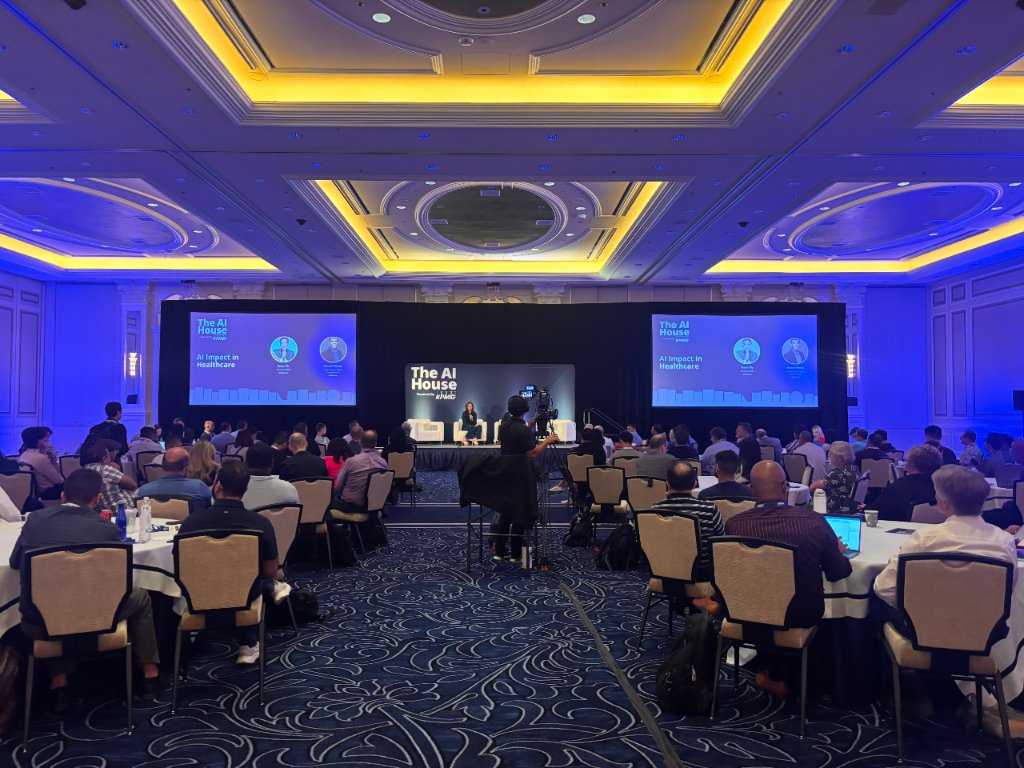
The AI House, a travelling event series produced by events company Modev with stops alongside major conferences including the AI Summit London, the AI Summit New York and CES, was presented at Ai4 by consulting giant KPMG. Behind its doors at The Venetian this week, executives, investors and founders gathered away from the noise of the 12,000-strong main event. The programming was polished. The excitement was real. But across every session, the same undertone kept surfacing: enterprises are racing to deploy AI agents into their businesses while still trying to work out whether they, or their customers, can trust the technology to do what it is told.
The anxiety has numbers behind it, and Australians helped produce them. A global study led by the University of Melbourne in collaboration with KPMG, surveying more than 48,000 people across 47 countries, found that while 66 per cent of people now use AI with some regularity, fewer than half say they are willing to trust it. The same research found more than half of workers who use AI do not disclose it, and have presented AI-generated work as their own.
That gap between adoption and trust was the unspoken subject of nearly every panel.
“A people transformation, not a technology transformation”
Nadia Hansen, Salesforce's global AI go-to-market leader for the public sector and a former chief information officer of Clark County, the Nevada county that includes Las Vegas, was blunt about where AI projects fail.
“It's a people transformation, not a technology transformation,” she told the room.
Hansen said the first question she hears from workers is whether AI will take their jobs, and that leaders who cannot answer it honestly should not expect adoption. Her prescription was unglamorous: start with a single job description, benchmark key performance indicators before and after, invest heavily in enablement, and survey staff on how AI is actually being used. The technology can do what you ask of it, she argued, but without strategy it cannot save you.
She also pointed to a conversation happening inside Salesforce that rarely makes it to conference stages: token budgeting, the practice of monitoring what AI models cost to run, query by query, so finance teams can see where the money goes. Cost, several speakers suggested, is the next frontier after capability.
The health frontier
Susan Sly, founder of women's health technology company The Pause, connected the AI conversation to a workforce crisis. With healthcare worker shortages deepening across developed economies, she argued remote monitoring, including RFID-enabled wearables, will have to carry more of the load.
Sly built her case on a principle summed up in the phrase “women are not small men”, coined by exercise physiologist Dr Stacy Sims. Health technology built on male-default data fails half its users, she argued, and AI trained on that data risks inheriting the same blind spot.
The founders building the fix
If the enterprises are the ones with the trust problem, a cluster of founders in the room are building businesses to solve it, and two of them, working independently, landed on the same diagnosis: the problem has outgrown the models themselves.
Hussain Sultan, founder of Xorq Labs, was in the audience and put it bluntly. “The honest admission in that room was that accuracy has gone up and trust hasn't, because trust was never a model problem,” he told this masthead. “It's a systems engineering problem: you don't need a smarter judge, you need answers that arrive with their own evidence.”
Tiarne Hawkins, whose company Optica Labs stress-tests AI systems for enterprises, framed the stakes the same way. As agents gain the ability to access data, call APIs and take actions, she argued, every new connection widens the attack surface, and the question shifts from whether a model can be trusted to whether everything the wider system can see and do can be. “You can't govern what you can't see, and you can't trust what you haven't tested,” she said.
The investors see the same shift. On a panel rethinking how startups are built and scaled, Momei Qu, Managing Director of PSP Growth, the venture arm of former US Commerce Secretary Penny Pritzker's PSP Partners, argued the biggest winners of the next 18 months will be on the infrastructure side, pointing to companies such as Together AI, Baseten, Fal and Fireworks AI. Open-source credibility and deep domain expertise, she suggested, are becoming preconditions for enterprise trust.
Aisha Tahirkheli, a principal in trusted AI and product risk at KPMG, told attendees that organisations need AI curriculum for every employee, not just technical teams, with responsible use at the centre. The mantra she offered the room: progress over perfection.
The view from Washington, and Canberra
For Australian readers, the takeaway from the AI House is less about any single product and more about the posture of the enterprises that dominate the global economy. These are the companies Australian businesses buy from, partner with and compete against, and behind closed doors their leaders describe an industry moving at rocket pace while its foundations, security, trust and governance, remain under construction.
The Albanese government's AI standards agenda and the Australian AI Safety Institute's frontier model testing programme are often framed at home as regulatory caution. Sitting in a Las Vegas ballroom listening to America's corporate AI establishment, it looked less like caution and more like the same two feelings on a national scale: a genuine belief that this technology will remake how the country works, held alongside an honest admission that nobody yet knows how to make it safe enough to trust. The excitement in that room was real. So was the nervousness. The most useful thing about the day was that, for once, the people building this were willing to show both.