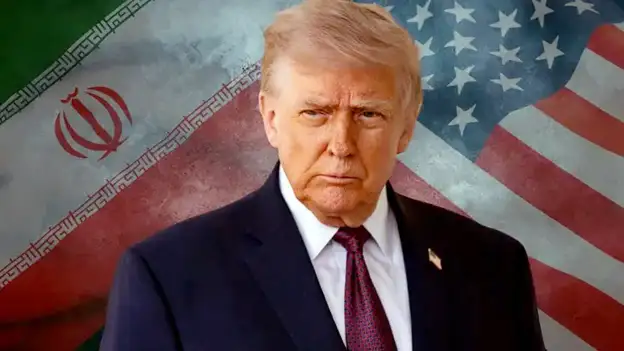
WASHINGTON — In a striking show of confidence in Australia's mining sector, the Pentagon will pour more than half a billion dollars into a world-first scandium project in the red dirt of central western New South Wales, anchoring a new US-aligned supply chain for a critical mineral long dominated by America's adversaries.
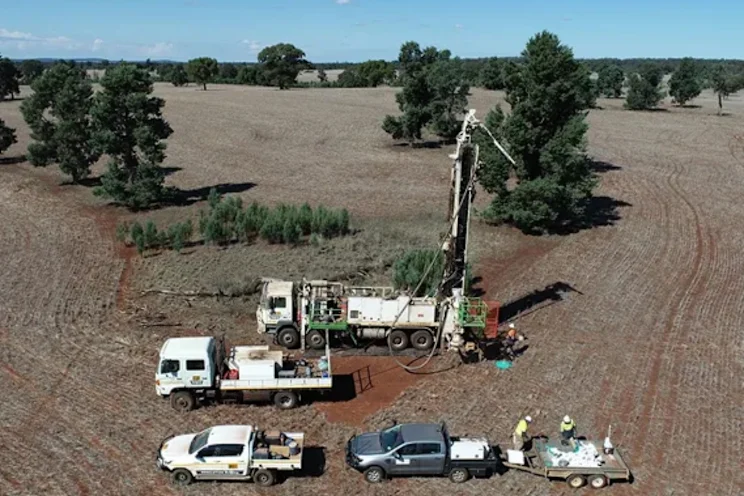
The $US400 million ($560 million) conditional loan, announced by President Donald Trump at a televised roundtable with mining executives at the US State Department on Friday, will expand production at Sunrise Energy Metals' Syerston Scandium Project near Fifield, south-west of Dubbo. The White House described the venture as “the world's first primary scandium mine” — a milestone in a quiet but consequential race to break Beijing's stranglehold on the minerals that power modern warfare.
Scandium, a silvery-white metal used to strengthen aluminium, is already woven through the aerospace, defence and clean-energy industries. It lightens fighter jets, hardens spacecraft and extends the life of fuel cells. Yet for decades, nearly all of the global supply has flowed from three countries: China, Russia and Ukraine. The United States has not mined the mineral on its own soil since 1969.
That dependence, Pentagon officials have warned for years, is a strategic vulnerability the country can no longer afford. The Defence Department estimates foreign competitors account for about 80% of global scandium production and nearly 100% of its processing.
A mine-to-metal chain across the Pacific
The loan, issued through the Pentagon's Office of Strategic Capital, is designed to build what officials describe as a “complete, US-aligned value chain from mine to finished metal” — a pipeline stretching from the sheep country of NSW to the assembly lines of American defence contractors.
The investment builds on a landmark deal signed last October between Mr Trump and Prime Minister Anthony Albanese in Washington, under which each country committed to providing at least $US1 billion for critical minerals projects. It was during that warm visit that Mr Trump vowed to uphold the AUKUS pact and laid the groundwork for a deeper commercial and strategic partnership in rare earths.
Just days after the leaders shook hands, Sunrise announced a five-year agreement for US weapons contractor Lockheed Martin to purchase up to 15 tonnes of scandium oxide — a deal that foreshadowed the Pentagon's broader bet on the Syerston site.
Commerce Secretary Howard Lutnick, speaking at the roundtable, framed the investment as part of a deliberate strategy to reclaim supply chains that have drifted eastward for a generation. “We're going to make sure the United States — not our adversaries — controls the supply chains of power and critical minerals,” he said.
Trump's mining revival
The State Department gathering brought together some of the most powerful figures in global mining. Representatives of BHP and Rio Tinto attended to discuss Resolution Copper, their proposed underground mine in Arizona that, when realised, is forecast to meet roughly a quarter of US copper demand.
Vicky Peacey, president of Resolution Copper, credited Mr Trump with reviving an industry that has languished under years of regulatory delay. “Mr President, you have brought mining back to America single-handedly,” she told the roundtable. “We started permitting in 2005 … we finally got it over the line earlier this year.”
BHP's North America president Jessica Farrell and the company's vice president for international affairs, Dominic Perrottet — the former NSW premier — were also present, a reminder of how closely Australian and American mining interests are now intertwined.
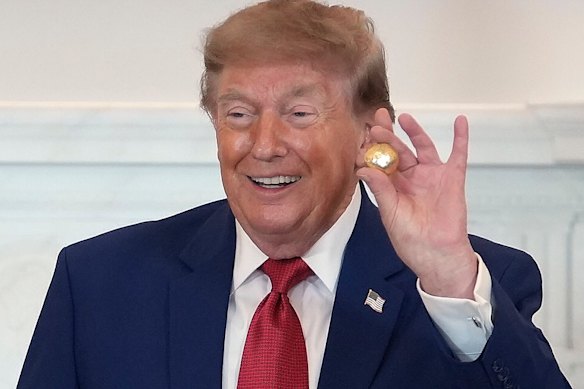
For Mr Trump, the announcement was a chance to showcase a tangible dividend of his administration's push for resource security. The president was photographed holding a solid gold replica of a deep-sea nodule, a gift from executives, as he outlined his vision for a revitalised American mining base.
A vote of confidence in Australia
Resources Minister Madeleine King welcomed the Pentagon's loan as a significant vote of confidence in Australia's critical minerals sector and its capacity to supply the minerals the US and its partners need. Scandium, she noted, has a range of aerospace, defence and clean energy applications that make it indispensable to the modern economy.
“No one country alone can create secure end-to-end supply chains in critical minerals and rare earths,” Ms King said — a sentiment that captures the logic of the US-Australia partnership as clearly as any policy document.
According to a federal government fact sheet, NSW holds the highest concentration of scandium in the world. Those deposits, long overlooked, have rapidly risen to the top of Washington's strategic agenda.
The Syerston project's momentum has been building for more than a year. Sunrise Energy Metals secured a $US67 million debt financing letter of interest from the US Export-Import Bank last September. Last month, the NSW government unveiled a royalty-deferral scheme that allows the project to postpone payments for five years, a program it described as an Australian first.
“The Syerston Scandium Project has been identified as a project of strategic importance under the US-Australia critical minerals partnership,” the NSW government said in a statement. “This support further reinforces the strategic necessity of bringing Syerston online as rapidly as possible.”
Another company, Canada-listed, Nevada-headquartered Scandium International Mining Corp, is also developing a scandium mine near Nyngan, NSW, and a nearby exploration site known as Honeybugle — a sign that the region is fast becoming a global hub for a mineral the world is only now learning to value.
A partnership built on shared ground
The investment arrives at a moment of deepening alignment between Washington and Canberra on resources and defence. Mr Albanese announced last year that Australia would create a $1.2 billion strategic reserve of critical minerals — lithium, rare earths, nickel, cobalt and graphite — to be purchased and held through special agreements with local producers.
Taken together, the initiatives sketch the outline of a new architecture: an allied supply chain stretching from the NSW outback to the factories of the American defence industrial base, designed to ensure that the minerals of the future are mined, processed and refined by the democracies that depend on them.
For the farmers and miners of the Lachlan Valley, the Pentagon's bet is something more immediate: a signal that the red dirt beneath their boots has become, almost overnight, some of the most strategically valuable ground on Earth.
I News Australia is an accredited member of the Australian media delegation covering official diplomatic engagements involving President Donald J. Trump.