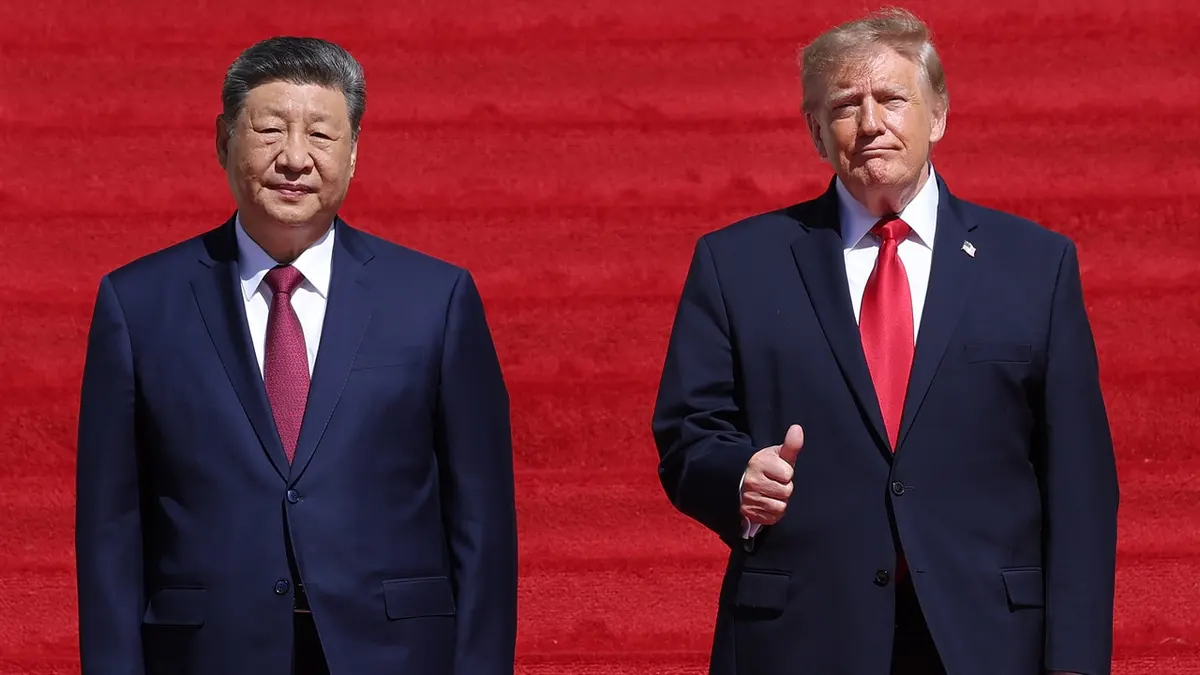
They smiled. They toured the White House. They promised warmer ties. And then they walked away with no joint statement and barely a single breakthrough to show for it.
President Trump and Chinese leader Xi Jinping's much-hyped Washington summit produced plenty of photo ops — and a whole lot of silence on the issues that actually matter.
On Monday, Beijing finally dribbled out a few details of what was agreed behind closed doors last week. The takeaway? Both sides issued separate accounts of the meeting — a telling sign that, despite the handshakes, Washington and Beijing still don't trust each other as far as they can throw each other.
Here's what we now know — and what's still dangerously unclear.
New AI dialogue — but no real guardrails
Beijing says the two powers agreed to launch a new AI dialogue, with further talks slated for the end of November. They've also set up a communication channel for AI-related "incidents" — bureaucrat-speak for trying to stop a robot screw-up from sparking World War III.
It's a modest step as both countries sprint to build ever-smarter machines — technology now baked into everything from Wall Street trading desks to Pentagon war planning. But the move comes amid growing alarm, with US firms like Anthropic pleading for a slowdown and revelations that OpenAI had already snooped around government websites in countries including Australia.
Trade truce gets a two-month lifeline
Chinese state media confirmed Monday what everyone suspected: the trade truce has been extended — but only until January 10.
The short reprieve guarantees both leaders will cross paths again at international summits later this year. Trump heads to the APEC summit in Shenzhen in November; Xi is due in Miami for the G20 in December. It's rare for the leaders of the world's two biggest economies to meet this often — a sign neither wants the relationship to spiral.
But Beijing had been gunning for a much longer extension. A two-month band-aid is a modest gain, not a grand bargain.
China did walk away with lower tariffs on $30 billion of goods entering the US — toys, small appliances, Christmas decorations — with reciprocal cuts expected from Beijing. The Trump administration also claimed Beijing will buy at least 10 million metric tons of American coal annually in 2027 and 2028.
Strikingly, there was no mention of China's rare earth minerals flowing to the US. And not a word about easing restrictions on advanced American semiconductors. The silence is loud.
Taiwan: the elephant in the Oval Office
The White House factsheet made zero mention of Taiwan. But Xi clearly made it a priority behind closed doors, urging Trump to formally oppose Taiwanese independence and handle the issue with "caution."
After their last meeting in May, Trump had openly mused about whether it made sense for US forces to "travel 9,500 miles to fight a war" over the island. This time? He was tight-lipped.
"We didn't talk about it too much," Trump told reporters over the weekend. "Right now, it's fine. It's just moving along. He understands very much how I feel."
That silence speaks volumes. Trump has previously called a proposed $14 billion US arms package for Taiwan "a very good negotiating chip" in his dealings with Beijing. The package has been on hold for months.
Adding to the confusion, US Ambassador to China David Perdue told Fox News that Trump had offered to sell weapons to Xi during the summit. The State Department later scrambled to clarify that US law prohibits arms sales to China — and there are no plans to do so. Oops.
Beijing sees the self-governing island as a breakaway province. Most countries, including the US, don't formally recognise Taiwan as independent — but Washington is committed to supplying it with weapons and opposes any attempt to take it by force.
China cracks open the door — but keeps the keys
China says it will let more foreign financial firms — American-backed banks, investment companies, insurers — apply to do business and open offices on the mainland. But any approval still has to clear Chinese laws and regulations.
That last line is the whole story. China is cracking the door — but Beijing still decides who walks through.
Foreign financial firms have long griped about regulatory barriers, licensing headaches and the threat of exit bans that make expanding in China a nightmare, even when access is technically allowed.
Beijing also said it's "discussing" more flights between the two countries — without explaining how. And despite handing visa-free entry to visitors from more than 75 countries, China still hasn't extended the courtesy to Americans.
Meanwhile, the US State Department still slaps a Level 2 advisory on travel to China, warning Americans to "exercise increased caution" over the risk of arbitrary law enforcement, exit bans and detention.
Bottom line: lots of talk, little change
This summit produced more dialogue — but almost no decision change. The most explosive issues, from advanced technology to Taiwan, remain unresolved.
For both leaders, it's a familiar outcome: a promise of more channels of communication, modest economic concessions, and just enough steady-handedness to keep the relationship from boiling over.
Both remain committed to a "steady" relationship. But as this summit proved, continued US-China dialogue is a whole lot easier than asking either superpower to actually compromise.